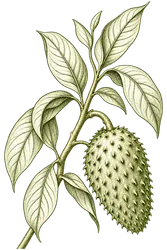
Soursop, also called graviola, arrives in cancer conversations with unusual credibility. It is a familiar Caribbean food, a long-standing household remedy, and a plant with genuine laboratory anticancer activity. But those three facts are often collapsed into a fourth claim that the evidence does not support: that taking soursop treats cancer in people. The harder part of the story is that one of the principal mechanisms behind its experimental anticancer activity, mitochondrial complex-I inhibition, is also central to its neurotoxic liability. Human causation has not been proven, but the neurological signal is serious enough that chronic medicinal use deserves a very different risk calculation from occasional food use.
A plant woven into Caribbean life
Soursop is not a recent arrival in Caribbean culture. Annona muricata originated in the Neotropics and was documented by early Spanish chroniclers in the West Indies. It subsequently became widely cultivated throughout the tropical Caribbean and beyond.[1] Its aromatic pulp became familiar as food, eaten fresh or turned into juice, punches, frozen desserts, sweets and other preparations.
Food and medicine have also never been entirely separate categories in Caribbean plant culture. Regional “bush medicine” developed through centuries of interaction among Indigenous American, African, European and later Asian traditions. Modern ethnobotanical surveys still record medicinal plants prepared as teas, infusions and decoctions for specific complaints as well as broader ideas such as “cooling”, cleansing and maintaining health.[2,3] Soursop fitted naturally into this household pharmacopoeia because the same tree supplied both food and medicinal material.
Surveys in Trinidad, Jamaica and Barbados document soursop leaves used in traditional preparations for hypertension, “nerves” and general health.[2–4] These observations do not establish that those remedies work. They establish something culturally important: for many Caribbean users, soursop-leaf tea is not an unfamiliar supplement discovered online. It may be something learned from family and prepared in the kitchen long before anyone develops cancer.
One tree, many exposures
The phrase “soursop use” can hide several chemically different exposures. More than 200 compounds have been reported from the plant overall, including annonaceous acetogenins, alkaloids and phenolic compounds.[7,31] Annonacin, a major acetogenin, is particularly relevant because it is a potent mitochondrial complex-I inhibitor and sits at the centre of much of the neurological research.
| Preparation | What we actually know | What not to assume |
|---|---|---|
| Fresh fruit / pulp | An average fruit was estimated to contain about 15 mg annonacin.[8] MSKCC currently says the fruit is generally safe to eat.[9] | That does not prove chronic high-frequency fruit intake is risk-free, nor can extract toxicology be transferred directly to eating intact fruit. |
| Juice / nectar | A commercial nectar was estimated at about 36 mg annonacin per can.[8] One tested commercial juice contained 16.2 mg/L annonacin plus multiple alkaloids.[29] | The measured juice was one product, not a universal concentration for all commercial juices. |
| Leaf tea / decoction | One analysed cup contained about 140 µg annonacin.[8] Herbal-tea exposure appears repeatedly in the Caribbean observational literature.[18,22] | Lower annonacin per cup does not automatically mean lower long-term exposure. Brewing method, frequency and years of use matter. |
| Extracts / supplements | Composition varies with plant part and extraction method. Commercial Annonaceae supplement materials have shown substantial neuronal toxicity after laboratory extraction and direct cell exposure.[10,31] | A “10:1” or “20:1” label does not tell you the annonacin or total acetogenin dose. |
| Seeds, root and bark | In one extraction study, A. muricata seed had the highest total acetogenin content among fruit parts tested.[32] Root-bark alkaloids damaged dopaminergic and GABAergic neurons in vitro.[11] | These materials are not ordinary fruit exposure and should not be treated as interchangeable with pulp or leaf tea. |
Supplements and concentrated extracts deserve their own category
Extraction changes the question. Water, ethanol, ethyl acetate and other methods pull different mixtures of compounds out of the plant, and the resulting material may bear little resemblance to the chemical exposure from eating the intact fruit. A concentration ratio on a bottle also does not establish the amount of annonacin, total acetogenins or neuroactive alkaloids actually delivered.
What the commercial-supplement experiment really showed
Höllerhage and colleagues tested plant materials from commercially available Annonaceae dietary supplements, together with fruit-pulp and seed materials. The researchers extracted those materials with hot pressurised ethyl acetate and then applied the extracts directly to cultured human mesencephalic neurons.[10] Several commercial supplement extracts strongly reduced neuronal viability. Among the fruit-pulp extracts, the A. muricata pulp extract was particularly neurotoxic, producing 67% cell death at 1 µg/mL in that assay.[10]
What it does show
- Commercial Annonaceae supplement materials can contain extractable constituents with marked neuronal toxicity in vitro.
- Plant materials and products do not behave uniformly.
- Fruit-pulp extract can be biologically very different from intact fruit.
What it does not show
- It does not show that eating soursop fruit produces the concentration applied to cultured neurons.
- It does not establish a human toxic dose for any capsule.
- It does not prove that a particular supplement causes parkinsonism.
The regulatory uncertainty is therefore important. A BfR-hosted risk assessment performed through the EFSA EU-FORA programme found indications of neurotoxic potential for certain A. muricata preparations, but concluded that inadequate long-term data prevented establishment of a safe intake level for soursop-based food supplements.[31] This was an EU-FORA technical risk assessment published in the EFSA Journal, not a formal EFSA Panel opinion.
The cancer claim: what the evidence actually shows
The anticancer research is not imaginary. Soursop extracts and acetogenins have shown cytotoxic and antitumour effects in a large preclinical literature, with proposed mechanisms including mitochondrial energetic stress as well as effects on HIF-1α, NF-κB, glucose metabolism, EGFR, Bax/Bcl-2 and cell-cycle regulation.[7,12] Those findings justify scientific interest. They do not establish a cancer treatment. That gap between the laboratory and the clinic is the subject of what “preclinical” actually means and why cancer results in mice so often fail in humans.
| Human evidence | What happened | What it can support |
|---|---|---|
| Randomized 30 colorectal-cancer patients | Leaf extract vs placebo for 8 weeks after tumour resection; 28 completed. Outcomes included ex-vivo serum cytotoxicity and nutritional measures.[13] | Not tumour efficacy. No tumour response, recurrence or survival endpoint. |
| Observational Bladder cancer | Ellagic acid + A. muricata after intravesical treatment; non-randomised.[14] | Cannot isolate a soursop effect from ellagic acid, selection effects or prior therapy. |
| Case report Hepatocellular carcinoma | Regression of lung metastases was reported while a patient consumed guyabano (soursop) fruit extract.[15] | A hypothesis-generating observation only. A single uncontrolled case cannot establish causation. |
| Registered pilot Advanced cancers | NCT04773769 planned graviola-leaf tea with radiographic response endpoints. The registry remains of unknown status and posts no results.[33] | No efficacy conclusion until results exist. |
The neurological signal: serious, but not the same as proof
Neurologists in Guadeloupe identified an unusually high proportion of atypical degenerative parkinsonism: syndromes often characterised by poor levodopa response, early postural instability, cognitive impairment and other features that differ from typical Parkinson’s disease.[18–21] Regular consumption of soursop fruit and herbal preparations was associated with the atypical syndromes in the early Guadeloupe studies, and later work continued to examine lifetime Annonaceae exposure.
The original case-control signal. In Guadeloupe, atypical parkinsonism was strongly associated with consumption of tropical plants including soursop fruit and herbal teas.[18]
A dose-effect signal within 180 Caribbean patients with degenerative parkinsonism. Even relatively low cumulative Annonaceae fruit or juice exposure, or any herbal-tea exposure, was associated with the more severe, cognitively impaired clinical cluster.[22] This addresses disease severity among people who already had parkinsonism. It is not a prospective proof that the exposure caused disease.
French Guiana added useful counterweight. Atypical syndromes made up 41.8% of degenerative parkinsonism there versus 66.2% in the French West Indies, while Annonaceae use was common in both populations.[24] The mismatch argues against a simple one-exposure explanation.
Caribbean Parkinson’s disease was clinically more severe than mainland-French PD in a cross-population comparison. Annonaceae-fruit exposure was reported by 71 of 74 Caribbean patients versus 0 of 20 mainland patients who were interviewed about exposure.[23] The groups still differ in many ways, so this remains observational evidence.
The neuropathology is also more nuanced than an earlier “pure tauopathy” story. In a 2025 postmortem series of eight Caribbean atypical-parkinsonism cases, five showed mixed tau/α-synuclein pathology, and the same study found that annonacin could influence protein aggregation in biophysical experiments.[25] The sample is small, but it suggests more than one kind of harmful protein is involved, not just the tau protein researchers first focused on.
What annonacin does to nerve cells
Annonacin works by shutting down part of a cell’s energy machinery, the very same action behind its effects on cancer cells. In laboratory tests on nerve cells it behaved as an extraordinarily powerful toxin, roughly 100 times more potent than MPP+, a chemical known to cause a severe, permanent form of parkinsonism in people exposed to it.[16] That comparison is striking, but it comes from cells in a dish, not from measuring what a dose does in the human body.
Experimental annonacin exposure can disrupt neuronal energy metabolism and tau localisation, and chronic administration has reproduced relevant basal-ganglia pathology in animals.[20,26] A 12-month mouse experiment went a step closer to a consumed preparation: mice drank a commercially available soursop juice, after which investigators observed increased cerebral tau phosphorylation, reduced synaptophysin and increased 3-nitrotyrosine markers.[29] That is a chronic oral whole-product animal model, still not proof of human disease, but importantly different from directly injecting purified annonacin.
“But annonacin is barely absorbed” is not a safety answer
Rat pharmacokinetic work found oral annonacin bioavailability of about 3.2% after a 10 mg/kg dose.[27] That number is sometimes tempting to turn into a conclusion in either direction. It should not be. Rat oral bioavailability does not tell us whether a human oral dose reaches an anticancer concentration, and it does not prove safety. Those questions require human pharmacokinetics, tissue concentrations and defined efficacy or toxicity targets that do not exist.
What the animal work does establish is that annonacin can be detected in rat brain after oral administration, demonstrating blood-brain-barrier penetration in that model.[28] Meanwhile, the human observational associations involve habitual fruit, juice and herbal-tea exposures, not only concentrated supplement megadosing.[18,22]
The evidence asymmetry is the real decision
The strongest case for caution does not require claiming that soursop has been proven to cause Caribbean atypical parkinsonism. It comes from comparing what is known about benefit with what is known about hazard.
Potential cancer benefit
- Substantial in-vitro anticancer literature
- Some animal antitumour evidence
- Multiple plausible mechanisms
- One tiny randomised human study with a laboratory surrogate
- No established tumour-response, recurrence or survival benefit
- No established anticancer dose or human PK target
Potential neurological harm
- Neurotoxic acetogenins and alkaloids identified in the plant
- Direct neuronal toxicity demonstrated experimentally
- Commercial supplement materials neurotoxic in vitro
- Orally administered annonacin reaches rat brain
- Chronic whole-juice exposure produces brain pathology in mice
- Decades of human observational association with atypical parkinsonism
There is no proof that soursop treats cancer in people. You also do not need proof of harm to weigh whether it’s a risk worth taking.
What this means if you or someone you love has cancer
- Do not treat all forms as equivalent. Occasional fruit, habitual juice, leaf tea, seed or root preparations and concentrated extracts create different exposures.
- Do not infer supplement safety from food history. The fact that soursop fruit is traditionally eaten does not establish the safety of concentrated extracts or chronic medicinal dosing.
- Do not infer human cancer efficacy from cell killing. Preclinical activity is a reason to research a plant, not proof that swallowing it treats a tumour.
- Tell the oncology team about use. MSKCC advises clinician review before graviola supplementation and also advises avoiding graviola around nuclear-imaging studies such as PET. The imaging concern is based on animal biodistribution data, so its magnitude in humans is uncertain.[9]
- Medication cautions remain provisional. Blood-pressure and blood-glucose lowering have been reported in animal models. The human clinical relevance is not established.[9]
The conclusion is therefore narrower, and stronger, than “soursop causes Parkinson’s”. Human causation remains undetermined. But there is no demonstrated human anticancer benefit to balance against a biologically coherent, potentially serious neurological safety signal. For anyone with cancer taking it long-term, that evidence asymmetry is the part that matters.
Last reviewed: August 2026.