Long before anyone called it “vitamin B17”, the apricot kernel already had a remarkably full life. It was food. It was medicine. It was pressed into cooking oil and massage oil. It was ground into pastes, combined with other herbs, rubbed into aching joints, worked into skin and hair, burned in lamps and incorporated into dishes prepared for guests. Across a broad belt stretching from East Asia through the Himalayas and into Persia and the Caucasus, people found different uses for the small seed hidden inside the apricot stone.
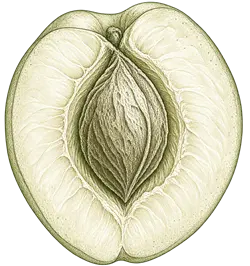
Those traditions were not all the same. Nor did they treat every apricot kernel as interchangeable. Sweet and bitter kernels were often recognised as different materials, suited to different purposes. In some places the distinction determined whether the kernel belonged in the kitchen or the medicine chest; elsewhere, the important distinction was between the intact seed and the oil extracted from it.[1]
Traditional knowledge was rarely an instruction to “take apricot seeds”. It was knowledge about which seed, prepared in which way, for which purpose.
Sweet and bitter: the first distinction
An apricot stone hides a kernel that may be pleasantly nutty or distinctly bitter. Modern chemistry tells us why that difference matters: bitter kernels generally contain considerably more of the cyanogenic glycoside amygdalin than sweet varieties. But communities using apricots did not need a laboratory assay to recognise that different kernels behaved differently. Taste itself became part of their practical classification.[2]
Nowhere is this more explicit than in Ladakh. There, apricots have traditionally been classified according to the kernel inside them: khante for bitter-kernel fruit and nyarmo for sweet. The distinction was functional. Sweet kernels could be eaten directly and were valued as a source of food and oil. Bitter kernels were preferentially directed toward oil extraction and other uses.[1]
That pattern is worth remembering as we travel east and west. There was no single ancient doctrine of the apricot kernel. What existed instead were local ways of deciding what kind of material one had in front of them—and what to do with it.
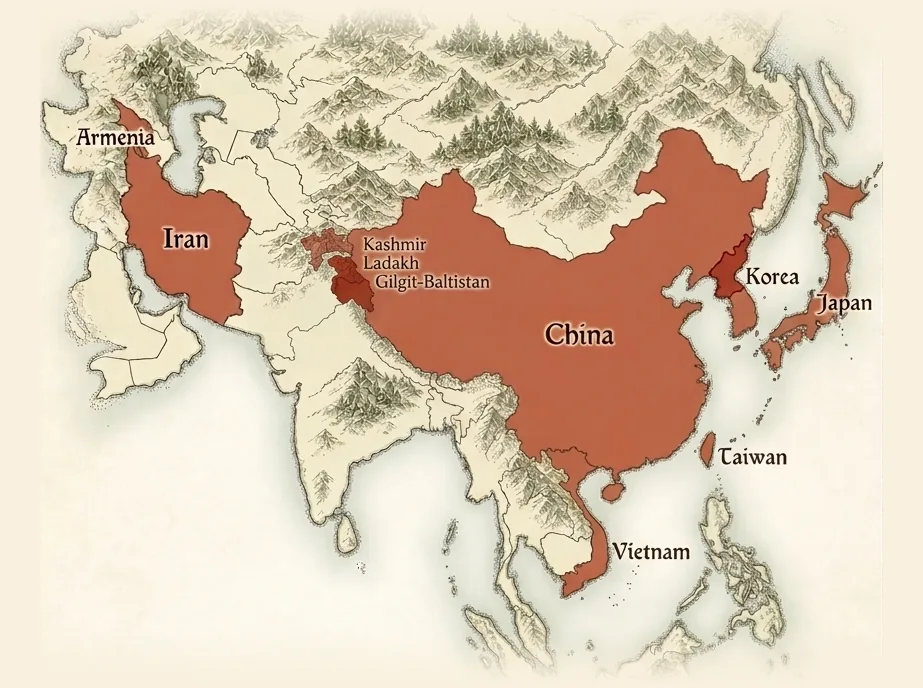
China: a seed becomes medicine
The most thoroughly documented medicinal tradition belongs to China.
Bitter apricot seed is known as Ku Xing Ren and, in formal materia medica, as Armeniacae Semen Amarum. It appears in the Shen Nong Ben Cao Jing, one of the foundational works of Chinese herbal medicine, whose received form dates to roughly two millennia ago.[3] Later materia medica continued to describe and refine its uses.[4]
Its traditional medical identity was remarkably stable. Ku Xing Ren was associated principally with the lungs and the large intestine: used in formulas for cough, wheezing and difficult breathing, and for constipation or intestinal dryness. Later texts expanded its applications, but the chest-and-bowel pattern remained central and survives in the modern Chinese Pharmacopoeia.[3]
The historical record also contains something easily lost when traditional medicine is reduced to a list of “active ingredients”: the seed was understood as a medicine with constraints. Chinese materia-medica sources described bitter apricot seed as possessing toxicity, while formal practice situated it within particular preparations and formulas rather than treating it as an unrestricted food. The current pharmacopoeial material is the dried ripe seed, harvested from mature fruit and specifically prepared as a crude medicinal drug.[3]
Korea, Japan, Taiwan and Vietnam: the materia medica travels
Apricot kernel did not remain confined to Chinese medicine. It became part of the wider East Asian materia-medica tradition, but what travelled was not simply a seed—it was a body of knowledge about how the seed should be handled.
In Korean traditional medicine the kernel is known as haengin. The Korean Traditional Knowledge Portal records the bitter kernel as a medicine acting principally on the lungs and large intestine, including uses for cough and asthma. The preparation instructions were specific: the outer coating and tips were traditionally regarded as undesirable or toxic and removed, producing a “cleaned” or “stripped” kernel; kernels could also be ground into a medicinal paste. The same source specifically warns against large quantities in children because of intoxication risk.[5]
That does not mean the old processing methods can be assumed to eliminate cyanide by modern safety standards. It means the medicine came with an acknowledgement that preparation mattered.
Japan retains apricot kernel—Armeniacae Semen, or kyōnin—as an official crude drug in its pharmacopoeia.[6] The same bitter-seed medicine, Ku Xing Ren, is used in Taiwan within the shared Chinese materia medica, carrying the characterisation it holds throughout that tradition: bitter, mildly toxic, and directed at the lungs and intestines.[3]
Vietnamese ethnopharmacological literature also records apricot seed for respiratory and digestive complaints, again echoing the therapeutic territory seen farther north. The evidence for the depth of that particular tradition is less richly documented in English-language historical sources than China’s, but it fits the wider East Asian pattern.[2]
Seen together, these traditions are a useful reminder that old herbal practices were often more sophisticated than the phrase “people used apricot kernels medicinally” suggests. They differentiated indication, preparation and dose; the kernel was one ingredient in a pharmacopoeia, not a universal tonic.
Ladakh: the apricot in household use
Move west across the mountains and the story changes. In Ladakh, the apricot is less a discrete medicinal drug than part of an entire household economy. The region’s cold, high-altitude environment made fruit preservation valuable, and apricots became deeply embedded in local food and material culture. Researchers documenting traditional knowledge there describe the apricot—locally chuli—as one of the region’s most important fruit crops.[1]
The sweet kernel could simply be eaten. Its oil could also become food: Ladakhi researchers recorded sweet-kernel oil being consumed alone or mixed with walnut oil. One traditional preparation, phemar, combines a spoonful of oil with finely ground roasted barley flour, salted tea and sugar and may be served to guests or during celebrations such as weddings.[1]
Bitter-kernel oil occupied another sphere. It was used on the hair and body and as a massage oil, with traditional uses for backache and aching joints; researchers also documented religious and cosmetic functions.[1]
The extraction itself was a craft. In villages surveyed in Ladakh’s Khaltsi area, families softened the hard stones in water, cracked them by hand and separated the kernels. Kernels were crushed in a communal stone mortar—rThun—then ground more finely into a paste. That paste was worked by hand over a gently heated stone known as a Ton-tsig, with small amounts of water added as the oil separated and collected in a groove in the stone. Researchers were documenting a process already disappearing as mechanical pressing became more common.[1]
Even the by-products were useful: shells could become fuel and kernel cake could be incorporated into other household uses. The result was less “a supplement” than an example of almost complete utilisation of a valuable seasonal crop.[1]
There is a real practical intelligence at work here. People did not merely know that apricot kernels existed. They knew their varieties, their tastes, their appropriate uses, how to crack them, how to grind them, how much heat the extraction stone should hold and what to do with what remained.
Kashmir and the north-western Himalayas: many apricots, not one
The wider north-western Himalayas add another important lesson: there was never one generic “apricot”.
A survey of traditional apricot diversity across high-altitude Jammu and Kashmir and Himachal Pradesh collected 147 samples representing 28 traditional local varieties. Local communities maintained different varieties for different purposes—some favoured as table fruit, others for drying—and kernel characteristics were part of that diversity. Apricot kernels were used as edible nuts and for oil production.[7]
That kind of local biodiversity matters. Modern supplement language tends to flatten plants into oversimplified ingredients: “apricot kernel”, “amygdalin”, “B17”. Traditional farmers encountered named varieties with different fruit, stone and kernel characteristics.
The knowledge began with the plant, not the molecule.
Gilgit-Baltistan region: where the whole tree mattered
Across the modern border in northern Pakistan, apricot culture becomes even more prominent.
In Gilgit-Baltistan—across districts such as Skardu, Ghanche, Hunza/Nagar, Astore and Diamer—apricot trees remain integrated into smallholder farming. Recent fieldwork describes apricot as the region’s most important fruit crop, accounting for around 62% of total fruit production. Fruit is eaten fresh in summer and dried for winter, when it can be used in soups and juices.[8]
Here again, the kernel was not one thing. Oil from sweet kernels is used in local foods, including a preparation called Hani-e-chzamik. Oil extracted from bitter kernels has traditionally gone elsewhere: into hair and skin care and into oil lamps. Kernel cake could be fed to livestock or used in hair washing.[8]
The biological diversity documented in the region tells the same story. In the recent Gilgit-Baltistan survey, 81% of the varieties sampled showed no kernel bitterness, while only a minority showed weak or strong bitterness. The food culture commonly described today as the culture of the “Hunza apricot” therefore encompassed a large diversity of apricots, many with non-bitter kernels.[8]
That distinction will matter later. For now, it is enough to see the tradition as it actually was: fruit for summer, dried fruit for winter, sweet kernels and oils as food, bitter oils for other household purposes, and virtually every useful part of the crop finding somewhere to go.
Persia: a different medical use
Farther west, apricot kernels entered a different medical tradition again.
Traditional Persian medicine developed a sophisticated pharmacological literature around foods, herbs, seeds and medicinal oils. Modern scholarship examining those sources reports the use of both sweet and bitter apricot kernels in Iranian traditional medicine, including preparations associated with memory and cognitive complaints.[9]
This is not as richly documented, at least in accessible English-language scholarship, as the Chinese Ku Xing Ren tradition, and it should not be made more precise than the sources allow. But it broadens the picture: the kernel’s medicinal identity was not confined to respiratory medicine, nor to a single civilisation.
Armenia: sometimes a kernel was simply food
In Armenia, another old centre of apricot culture, the kernel appears in a refreshingly uncomplicated role: as a nut.
An ethnobotanical survey of Yerevan markets recorded Prunus armeniaca seeds among the edible nuts bought and consumed locally. The same tree provides fresh and dried fruit, preserves and drinks; even its wood has an important cultural life, traditionally used in instruments including the duduk.[10]
That may seem less dramatic than a two-thousand-year-old medicinal indication, but it belongs in this history for exactly that reason. Not every culture that valued the apricot kernel needed to turn it into medicine.
Sometimes a useful, nutritious kernel was simply something worth eating.
What the old traditions actually have in common
There is no single “ancient apricot-kernel tradition” running uninterrupted from China to the Caucasus.
There are several.
In China and the medical traditions influenced by it, bitter kernel became a carefully defined herbal drug. In Ladakh, sweet and bitter kernels belonged to different parts of domestic life, while a sophisticated communal craft grew around extracting their oils. Across the north-western Himalayas, farmers maintained numerous local apricot varieties and used kernels as food and oil. Gilgit-Baltistan developed an almost whole-crop economy in which sweet kernel, bitter kernel, oil, cake, fruit and even shell could have different destinations. Persian medicine incorporated kernels into yet another therapeutic vocabulary. Armenian food culture kept the seed on the table.
Perhaps the closest thing to a shared tradition is therefore not a particular medical claim.
It is specificity.
Which apricot variety?
Sweet or bitter?
Whole kernel or oil?
Food or medicine?
Taken alone or in a formula?
Processed how?
Those distinctions were embedded in traditional knowledge.
And then came Hunza
It is fitting that the modern story begins near the place where the traditional one is richest.
During the twentieth century, Hunza acquired an extraordinary reputation in Western popular writing. Visitors described an isolated mountain population apparently enjoying exceptional health and extraordinary longevity. Claims emerged of people routinely surviving beyond 100—and sometimes 120—years.[11]
There really were reasons for outsiders to be fascinated. Hunza had a distinctive high-altitude food culture, extraordinary apricot diversity, strenuous daily physical activity and a way of life that looked very different from industrialised Western society.
Their mistake wasn’t finding this interesting, it was turning their observations into mythology. And it began with the name. There is no single “Hunza tribe”. That’s a popular oversimplification. Hunza is a multi-ethnic and multilingual region.[8] Similarly, the tales of their exceptional health and longevity were, unfortunately, unsubstantiated lore.
Age documentation in historical Hunza was inadequate to verify the spectacular longevity figures. When gerontologist Alexander Leaf visited the region, he found that the claimed ages of its oldest inhabitants could not be substantiated by records. Modern longevity researchers use “Shangri-La” longevity myths as a category for precisely this kind of geographically anchored claim of extraordinary lifespan without adequate age validation.[12]
From there, the apricot became irresistible.
A population famous for longevity grew enormous quantities of apricots. Apricots contained kernels. Bitter kernels contained amygdalin. And a twentieth-century alternative-cancer movement was already promoting amygdalin and its relative, laetrile, eventually rechristened “vitamin B17”. Laetrile had entered cancer treatment decades earlier and became enormously popular in the United States in the 1970s; the “B17” designation was itself a twentieth-century promotional invention rather than an accepted vitamin classification.[13]
Eventually these separate facts were woven into a much cleaner story:
The Hunza eat apricot kernels.
The Hunza live extraordinarily long lives.
The Hunza don’t get cancer.
Therefore apricot kernels prevent cancer.
While the first statement contains a fragment of genuine regional food history, the rest does not follow from it.
There is no validated demographic evidence for the legendary Hunza ages, and no population cancer registry established a cancer-free Hunza population. The regional ethnobotanical evidence we now have is much more nuanced than the myth: it documents diverse apricot varieties, widespread use of fresh and dried fruit, culinary use of sweet-kernel oil and household/cosmetic use of bitter-kernel oil.[8]
That does not diminish the traditional knowledge.
It restores it.
Apricot kernels really do carry centuries of food and medicinal history. Respecting that history means preserving its distinctions, not reducing it to “ancient people discovered amygdalin.”
The traditional story is richer than that. It is the story of Chinese physicians assigning a potent seed a particular place in a pharmacopoeia. Of Korean medicine retaining rules for how that seed was prepared. Of Ladakhi families sorting apricots by taste before deciding whether the kernel belonged in food or oil. Of mountain communities sharing stone equipment to press their annual harvest. Of Gilgit-Baltistan households finding uses for fruit, kernel, oil, shell and cake. Of Persian healers incorporating kernels into another tradition of medicine. And of Armenian markets treating the apricot seed simply as another food worth keeping.
That history does not need to prove a cancer cure in order to deserve respect.
And perhaps that is where the modern misunderstanding began: a long tradition of knowing how to use a plant was mistaken for evidence that the plant had always been used for what we wanted it to do now.
The companion article asks whether the modern apricot-kernel and laetrile cancer claim survives scientific scrutiny. This article has had a different purpose: it gives the kernel its history back.
Last reviewed: August 2026.